


Have you ever placed a crypto trade expecting one price, but received a slightly different execution price?
That difference is called slippage: the gap between your expected price and the actual filled price.
 KuCoin Trading Bots
1. What Exactly Is Slippage?
Slippage = Expected Price − Actual Execution Price
Example: You want to buy 1 ETH at 3,000, but due to market conditions, your order is filled at 3,015. That’s $15 in slippage.
2. Why Does Slippage Happen?
-
Market Volatility: Prices move fast. In the milliseconds between order and execution, the price can change, especially during high-volatility periods like news events or high trading volume.
-
Low Liquidity: Liquidity refers to how easily an asset can be bought or sold without impacting its price. If there aren’t enough buy/sell orders near your target price, your trade may "slip" to the next available price.
3. How Slippage Impacts Your Trades
-
Higher Costs: Paying more to buy or receiving less when selling.
-
Strategy Disruption: Especially affects scalping, arbitrage, and stop-loss orders.
-
Large Order Impact: The bigger your order, the more slippage you might experience.
4. How to Reduce Slippage
-
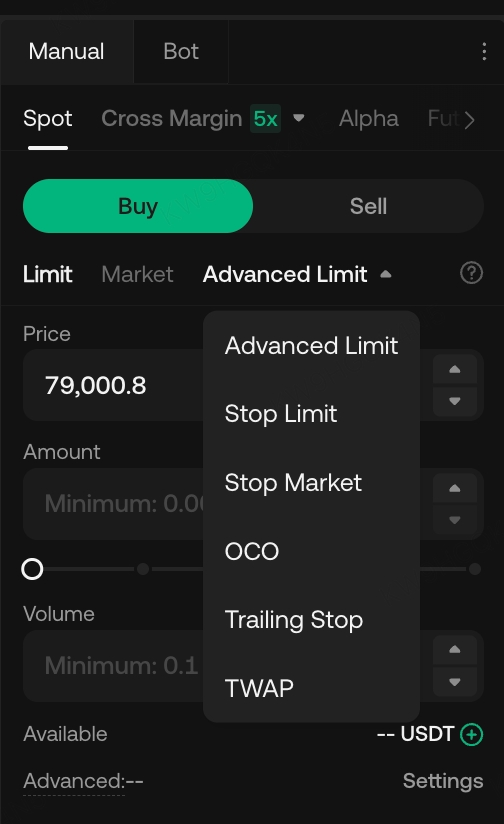
Use Limit Orders: Set your exact price. The trade only executes if the market reaches that price. (Note: Your order may not fill if the price doesn’t reach your limit.)
-
Trade High-Liquidity Pairs: Stick to major pairs like BTC/USDT or ETH/USDT, where order books are deeper.
-
Avoid Extreme Volatility Times: News events, major economic releases, or low-liquidity hours (like weekends) often see higher slippage.
-
Split Large Orders: Break big trades into smaller chunks to reduce market impact.
5. KuCoin Tools to Help Manage Slippage
KuCoin offers built-in features to give you more control:
✅ Post-Only Orders – Ensures your order adds liquidity (maker order), helping avoid taker fees and reduce slippage.
✅ Real-Time Order Book – Visually check market depth before trading.
✅ IOC (Immediate-or-Cancel) Orders – Fills immediately at available prices, cancels the rest. Ideal for partial fills without unwanted slippage.
✅ KuCoin Trading Bots – Like Grid Trading, which automates limit orders in a range, aiming for better average entry prices. (Link: https://www.kucoin.com/trade/strategy/BTC-USDT)
KuCoin Trading Bots6. Final Tip: Always Check the Order Book
Before you trade, glance at the order book.
-
Tight spread between bid and ask? ✅ Good sign.
-
Deep order book with large volumes near your price? ✅ Even better.
-
Thin order book with big gaps? ⚠️ Slippage risk is higher.
Disclaimer: This content is for educational purposes only and not financial advice. Trading carries risk. Consider your risk tolerance and trade responsibly.